

The story so far…
Throughout our first five sessions we have explored the Western world’s understanding and practice of happiness and wellbeing, which we have summarised with the words, “Health, Wealth and Pleasure.” The less material dimensions however, especially relationships and meaning, appear to have suffered, leaving many people yearning for more.
Finding our way – the importance of meaning in life
 In the previous session we focused on relationships and saw how fundamental they are to wellbeing. For this final session we will concentrate on that other crucial dimension – meaning. Human beings cannot long survive without a sense of meaning and purpose in life. As psychologist Robert Emmons puts it, “Meaning-making is an activity that is distinctly human.”
But meaning is tricky
What does “meaning” actually mean? What is the meaning of meaning? Well, you could regard it as the invisible explanation for a visible entity, be that a simple word or a gesture, or something profound, like “the meaning of life.” Something vitally important, something that explains and clarifies what appears on the surface lies unseen, unspoken, hidden. It is not obvious, and some effort is required to discover it. Perhaps that goes some way to explain why we struggle with meaning in our “instant” culture.
Examples
A gesture may have a very clear meaning in one culture, but in another it may mean something very different. For example, in Lebanon, tutting in response to a question signifies simply “No”, whereas in the UK it indicates irritation. The gesture is the same, but the meaning is very different. Such cultural differences occur in many contexts. The visible action appears very clear, but the invisible meaning is not!
Back to stories
In Session 2 we explored the importance of stories in all our lives, whether personal, familial or cultural. We saw that what makes a random collection of happenings into a story is the storyline, or narrative. It gives interpretation, understanding and meaning to an otherwise ragtag assortment of events and ideas. In Session 2 we investigated the Western narrative of The Good Life, and found it to be a very particular one, focussing especially on the material realm.
Big and little stories – a double narrative
 All stories are not the same, of course. Each culture possesses a Big Story, an attempt to explain and give meaning to the whole of life, including the universe, the world, humanity – and me! But as individuals, we all have a personal story too, simply through being alive and having a history. The result is a double narrative: “my story” and the “Big Story. Both play a key role in our lives, and most people would agree that life meaning is to be found within these stories. So, how do they connect and what does that mean for me and for others?
Big Story – especially in the West
A culture’s Big Story claims to explain everything significant in life, including my life. So, it is well worth trying to understand our own culture’s Story, since it underpins everything we think, say and do (usually without us ever thinking about it!). All through this course, we have described the Western Story in terms of health, wealth and pleasure, with the material sphere dominating much of life.
Any Story seeks to answer the four Big Questions of life: What does everything consist of? How does it work? Who am I/are we? Why am I/are we here? The Western Story has provided some impressive answers to the first two questions, especially via science and technology – dealing primarily with material realities. However, these alone are not sufficient to address the other two questions. In fact, science was never designed to tell us who we are, nor why we are here – at least not in the deeper realms of life.
A deeper story
What is required is a storyline, a narrative (sometimes called a metanarrative, because it seeks to encompass and explain everything), that is equipped to explain not just the visible material domain, but that which lies beyond it, i.e. the less observable areas addressed by the “who” and the “why” questions. It needs to offer a way of explaining all those longings we experience, the mysteries of relationships and the domain that refuses to go away – what many would call the spiritual realm.
My story
All this talk of the Big Story may seem beyond our reach. What is not so far off however, is our own story. And yet that story too raises questions that we struggle to answer – why did I experience that pain, why did my parents abandon me, who am I and what’s my life all about anyway (notice that these are much more “who” and “why’ questions than “what” and “how”)?
Feeling the pain
 It is here that our challenges, disappointments and pains can teach us more than material pleasures and easy answers. It’s significant that our right brains, connecting as they do with the real world around us, empathise with other people’s experiences (including their griefs and sorrows) and, because of this, produce more melancholic and sad perceptions/responses than the left brain (with is more associated with happy feelings). The Greek word pascho has several dimensions of meaning, ranging from simply feeling, to being affected by other things/people, right through to suffering pain physically and emotionally. From pascho we get both the words pathology and apathy, but also sympathy, empathy and pathos. This is all right brain territory, and we might summarise this thus – the one who loves the most suffers the most!
There is a deep paradox here. As the psychologist Erich Fromm put it, “To spare oneself from grief at all costs can be achieved only at the price of total detachment, which excludes the ability to experience happiness.” The irony is that the more we pursue pleasure and avoid pain, the more we detach from the joys and pains of other people – and ourselves! At root, we want to have healthy relationships and a sense of meaning and purpose. And yet the route to these things usually involves both joy and suffering.
Bringing it together
One recent study investigated the contrasting relationship between happiness vs meaning (approximating to Seligman’s Pleasant life on one hand and the Engaged and Meaningful Lives on the other). The researchers concluded that, like other animals, we strive for (material) happiness, focusing on what we can get. But, unlike animals, we also quest for meaning, characterised by what we can give. These two desires are in profound contrast (compare those contrasting wants and longings of Session 4), and perhaps sum up the two sides of our guiding diagram. The classic example is that of parenting. We desire to be parents, to experience satisfaction and pleasure; and yet parenting can often be excruciatingly painful, as we also experience challenges, disappointments and even rejections. But it is profoundly meaningful, and not dependent simply on outer pleasures.
A metaphor: Tree of Life
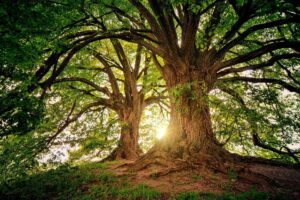 A metaphor may help us to draw the many strands together. Trees consist of three main parts – root, shoot and fruit. The roots, though invisible, provide the foundation for the whole plant. They absorb all that is necessary for life, but also provide foundations of stability and security. The shoot (or trunk) grows out of the roots and unlike them, is visible to all the world. It supports the whole of the tree and must be both strong and straight. The fruit (and branches and blossom) are most obvious parts of the tree and connect most fully with the world around.
The roots can be seen as the core of who we are (as individuals and societies) – they represent the foundations, the “why” of our lives. Everything springs from here, and is dependent on the health or otherwise of the root system. What cannot be seen by others is nonetheless the source of all we are. The shoot provides the bridge between the unseen parts of our lives and the most visible parts, “on show”. It represents those relational connections and life roles. Finally, the fruit points to the consequences of our thoughts, words and actions, impacting and intersecting with the world around.
This raises a number of questions of course…
- What gives us rootedness in our personal and societal lives? What impact is the soil having?
- How straight is our “shoot”? Is it resourced sufficiently by the roots to enable it to support the whole plant?
- What does a fruitful life look like? If someone was to take a taste of your fruit, would it be nourishing or toxic?
Finally…
Perhaps the simplest way of expressing it all is this: how would you complete this statement: the reason I was put on this planet is…(another way of saying, the purpose of my life is….)

